
How long does it take for weed to be cleared from the body Completely
If you smoked once at a party or you use cannabis every night to unwind, you have probably typed some version of this question into Google at 2 a.m. The honest answer is that it depends, but not in a vague way. Once you understand how THC actually moves through your body, you can predict your own timeline with real accuracy instead of guessing.
This guide walks through how long does it take for weed to be cleared from the body based on real pharmacology, not internet myths. We will cover how long does weed stay in your system for each test type, what changes the timeline, and how to read your own risk level honestly.
The Short Answer First
For a single use, THC and its metabolites are usually gone from urine within 3 to 10 days. For daily or heavy use, full clearance can take 3 to 5 weeks, and in rare cases of very heavy long term use, traces have been reported past 60 days.
That range is wide because THC does not behave like alcohol or most other drugs. It does not just dissolve in water and flush out. It hides in your fat cells and leaks back into your bloodstream slowly over time. That single fact explains almost everything else in this article.
How THC Moves Through Your Body
When you smoke or vape cannabis, THC hits your bloodstream within minutes and reaches peak levels in your blood in about 6 to 10 minutes. If you eat an edible, absorption is slower and less predictable, with effects starting 30 to 90 minutes after eating and peaking around 2 to 3 hours later.
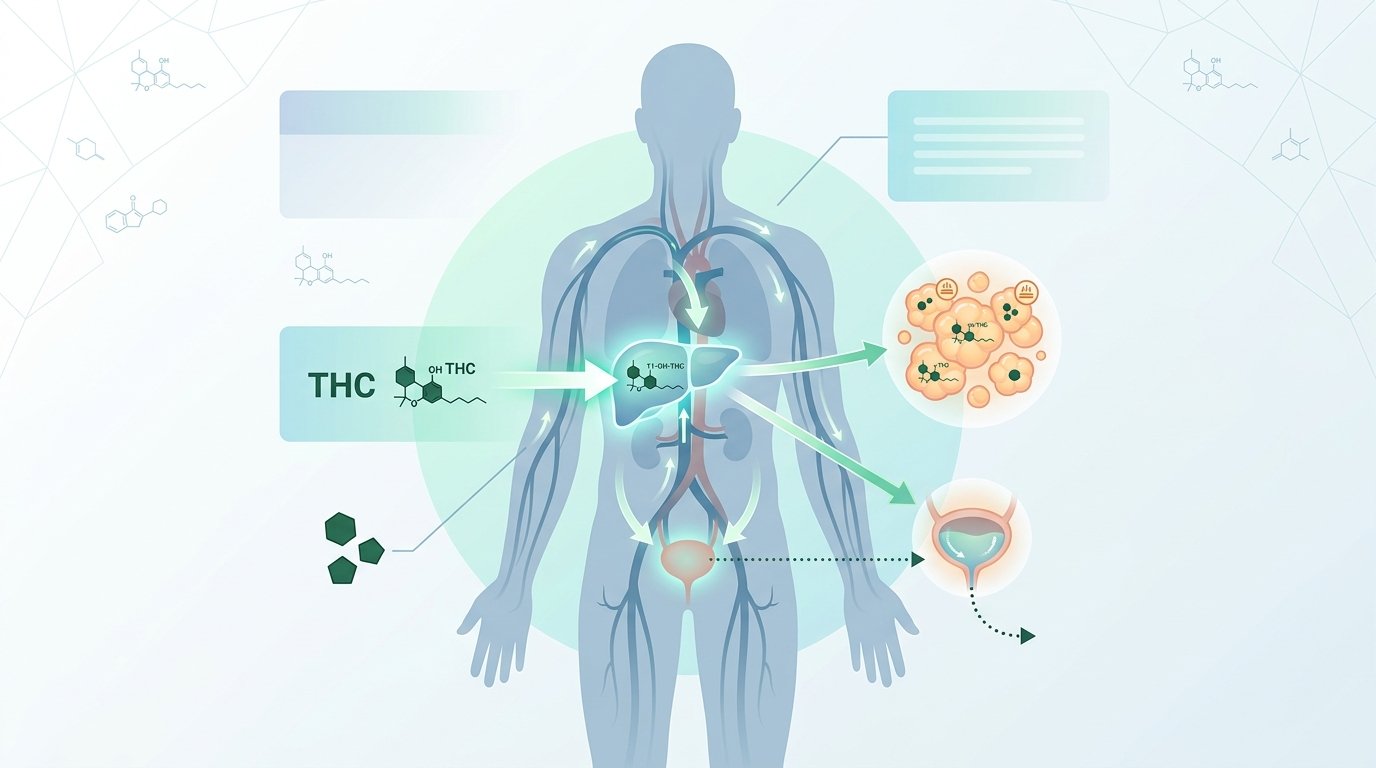
From there, your liver gets to work. It converts THC into an active metabolite called 11-OH-THC, which is actually more potent than THC itself. Your liver then breaks that down further into 11-COOH-THC, commonly written as THC-COOH. This inactive metabolite is what most drug tests are actually looking for.
Here is the part that matters most for your detection window. THC and THC-COOH are lipophilic, meaning they are attracted to fat rather than water. Instead of getting filtered out quickly like a water soluble compound would, THC gets stored in your fatty tissue. From there it slowly releases back into your blood, gets reprocessed by your liver, and eventually leaves through urine and feces.
This is why THC metabolism does not follow a simple one time countdown. Every time you use cannabis, you are adding more THC to a slowly draining reservoir rather than starting a fresh clock.
What THC Half Life Actually Means
THC half life refers to the time it takes for the amount of THC in your body to drop by half. This is not the same as detection time, but it explains why detection time varies so much between people.
For someone who uses cannabis only occasionally, research generally places the half life of THC at around 1 to 1.3 days, meaning most of it clears the bloodstream relatively fast. For regular or daily users, the half life stretches out to roughly 5 to 13 days because fat stores keep releasing THC back into circulation.
Since it typically takes about five half lives for a substance to be considered essentially eliminated, that math alone shows why occasional users can be clear in under a week while daily users may need a month or more.
How Long Does Weed Stay in Your System by Test Type
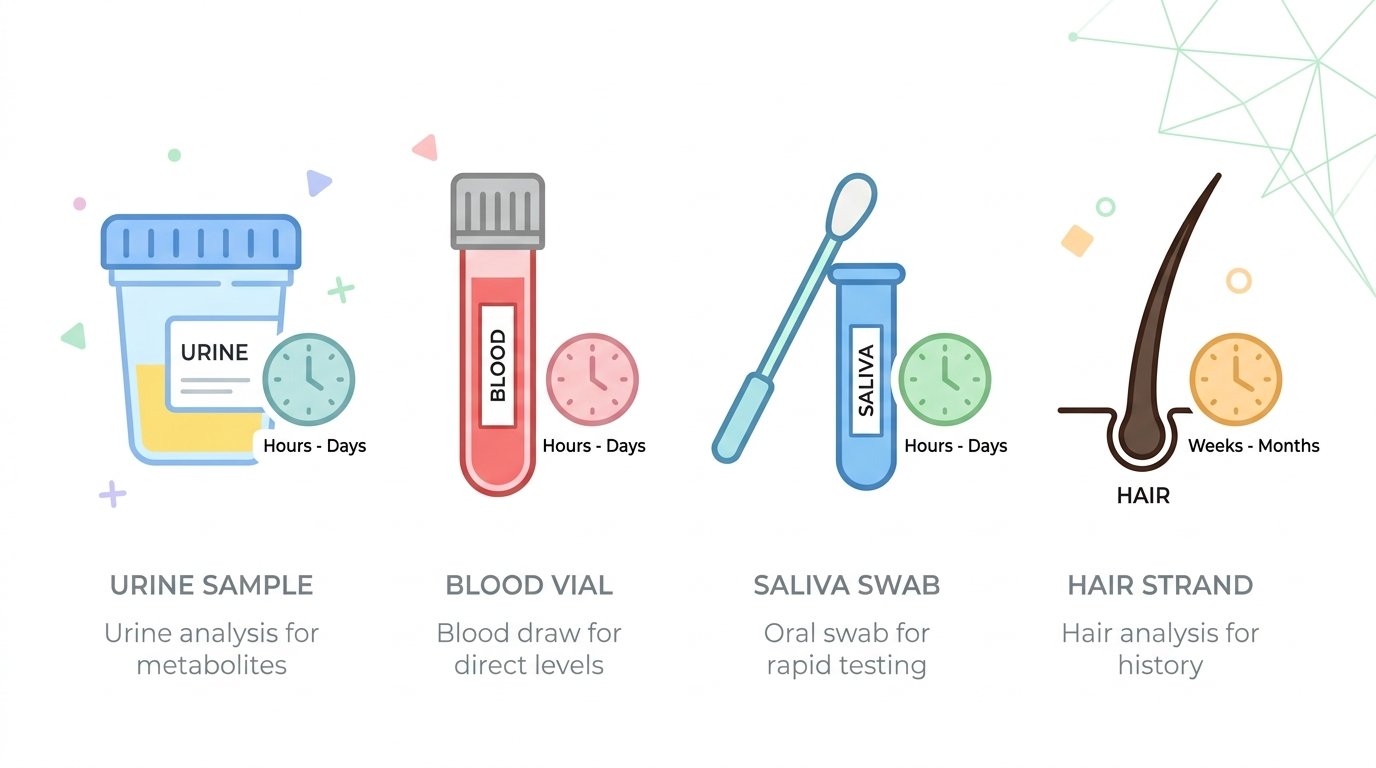
Different drug tests look at different parts of your body, and each one has its own detection window. This is the main reason people get conflicting answers online. A saliva test and a hair test are not measuring the same thing at all.
How Long Does Weed Stay in Urine
Urine testing is the most common method used by employers and probation programs because it is affordable and has a longer detection window than blood or saliva.
Here is a realistic breakdown based on usage pattern:
- Single or one time use: 3 to 8 days
- Occasional use, a few times a month: up to 7 to 10 days
- Moderate use, several times a week: 7 to 21 days
- Daily or near daily use: 15 to 30 days
- Chronic heavy use over months or years: 30 to 45 days, with rare outlier cases stretching further
A commonly repeated claim online is that cannabis can sit in urine for 60 to 90 days for anyone. That is not typical. Reviews of drug testing data suggest the widely circulated 30 plus day window is closer to a worst case scenario for extremely heavy, long term users rather than a normal outcome, even at more sensitive lab cutoffs.
How Long Does THC Stay in Urine After One Hit
This is one of the most searched questions, and the answer surprises a lot of people. Even a single hit or one puff can occasionally show up on a sensitive test for a few days, because standard immunoassay screens use a 50 nanogram per milliliter cutoff, while confirmatory lab testing with gas chromatography mass spectrometry can detect THC-COOH at levels as low as 15 nanograms per milliliter.
In practice, most first time or one time users test negative within 3 to 5 days on a standard test. If a more sensitive cutoff is used, that window can extend slightly, but it rarely goes beyond a week for a true single use.
How Long Does an Edible Stay in Your System
Edibles tend to produce slightly longer detection windows than smoking the same amount of THC. Because edibles pass through the liver before reaching the bloodstream, they generate more of the 11-OH-THC metabolite, which then converts into more THC-COOH for your body to store and clear.
Some clinical comparisons suggest edibles can extend detection windows by roughly 20 to 30 percent compared to smoking at a similar frequency. So if you are an occasional edible user, expect urine detection in the 5 to 10 day range rather than 3 to 8 days. Daily edible users should expect their timeline to sit at the higher end of the daily use range, closer to 30 days.
How Long Does THC Stay in Blood
THC blood tests look at the active drug itself rather than the inactive metabolite, which makes blood testing useful for measuring recent impairment rather than long term use.
Active THC is typically detectable in blood for a few hours up to about 12 hours after use. Heavy, chronic users can sometimes show detectable THC in blood for a day or two longer because of residual release from fat stores, but blood testing is generally reserved for accident investigations, DUI cases, and certain clinical settings rather than routine employment screening.
How Long Does Weed Stay in Saliva
Saliva testing, also called oral fluid testing, has become more common for roadside testing and some workplace programs because it reflects very recent use.
For occasional users, THC in saliva is typically detectable for about 24 to 72 hours. For frequent or heavy users, that window can stretch closer to 72 hours or slightly beyond, though it rarely approaches the length of a urine test window.
Worth knowing: the Department of Transportation has been working on rules to allow oral fluid testing as an alternative to urine testing for federally regulated employers, though full implementation has depended on laboratory certification timelines.
How Long Does Weed Stay in Hair
Hair follicle testing has by far the longest detection window of any standard method, and it works differently than the other tests. As hair grows, small amounts of THC metabolites become embedded in the hair shaft, creating a rough timeline of use.
Standard hair tests typically look at the most recent 1.5 inches of hair growth, which generally corresponds to the past 90 days. This test does not tell you about a single use from years ago, and it is not usually reliable for detecting one time or very light use, since hair testing works best for identifying a pattern of regular use rather than an isolated event.
Factors Affecting THC Detection Time
Two people can smoke the exact same amount of weed and get completely different test results a week later. Here is why.
Frequency of Use
This is the single biggest factor. Someone who used cannabis once has almost no fat stored THC to slowly release. Someone who uses daily has been building up a reservoir for weeks or months, and that reservoir keeps leaking THC back into the bloodstream long after the last use.
Body Fat Percentage
Because THC is stored in fat tissue, people with a higher body fat percentage generally retain THC metabolites longer than people with lower body fat, all else being equal. This is not about weight alone, it is specifically about fat storage.
Metabolism and Liver Function
Your liver does the heavy lifting of converting THC into its metabolites. People with faster metabolisms and healthy liver function tend to process and clear THC-COOH more efficiently. Liver conditions or certain medications can slow this process down.
Potency and Dosage
Cannabis products sold today are significantly stronger than what was common in past decades. Government seizure data has shown average THC potency in cannabis products climbing from under 4 percent in the mid 1990s to over 16 percent by the early 2020s, and legal dispensary concentrates can now exceed 40 percent THC. Higher potency means more total THC entering your system per use, which means more available to store in fat.
Method of Consumption
Smoking and vaping deliver THC directly to the bloodstream through the lungs, producing a fast but often shorter tail compared to edibles, which route through the liver and tend to extend detection slightly.
Hydration
Drinking more water will not meaningfully speed up how fast your body eliminates THC-COOH, but it can dilute the concentration in a single urine sample. Labs routinely check for this using creatinine normalization, and a sample that is too diluted can be flagged or rejected, which usually causes more problems than it solves.
Exercise Timing
Exercise burns fat, and since THC is stored in fat, intense exercise can theoretically release stored THC back into the bloodstream temporarily. This means working out right before a test could actually raise your THC level slightly rather than lower it, even though consistent exercise over weeks supports overall metabolism.
Detection Time by Usage Pattern
To make this easier to apply to your own situation, here is a simple comparison across common usage patterns for urine testing, which is the most widely used method.
| Usage Pattern | Typical Urine Detection Window |
|---|---|
| First time or single use | 3 to 8 days |
| Occasional, a few times a month | 5 to 10 days |
| Moderate, several times a week | 7 to 21 days |
| Daily use | 15 to 30 days |
| Chronic heavy daily use | 30 to 45 days, occasionally longer |
These numbers are ranges, not guarantees. Your personal result depends on the combination of factors above.
Common Mistakes People Make About THC Clearance
Assuming one number applies to everyone. The “weed stays in your system for 30 days” claim gets repeated constantly, but it is really a worst case number for heavy chronic users, not a universal rule.
Overloading on water right before a test. Extreme water loading can trigger a diluted sample flag at the lab, which some employers treat the same as a failed test.
Exercising heavily the day of a test. As mentioned above, this can temporarily raise measurable THC levels instead of lowering them.
Confusing impairment with detection. The high from smoking weed usually fades within 2 to 4 hours, but that has nothing to do with how long metabolites remain detectable in urine or hair. You can feel completely sober while still testing positive.
Trusting detox products for guaranteed results. No supplement, drink, or cleanse has been shown to reliably eliminate stored THC metabolites faster than your body’s natural pace. Time and abstinence remain the only consistently effective approach.
Ignoring edibles as a separate category. Many people assume edibles clear faster than smoking since there is no smoke involved. In reality, edibles often take slightly longer to clear because of how the liver processes them.
Frequently Asked Questions
Final Thoughts
There is no single number that answers how long does it take for weed to be cleared from the body for every person, because your timeline depends heavily on how often you use, how much body fat you carry, your metabolism, and which type of test is being used. What stays consistent across all the research is this: THC lingers longer than most people expect because it hides in fat tissue rather than washing out quickly like alcohol.
If you are facing a specific test with real consequences, the safest approach is honest self assessment based on your actual usage pattern rather than hoping a shortcut works. Time, consistent abstinence, and understanding your own usage history will always give you a more accurate picture than any online calculator or detox product claim.
For deeper reading on the pharmacology behind THC metabolism, the National Institute on Drug Abuse and the peer reviewed pharmacokinetics literature referenced throughout this article remain the most reliable sources available.
Sources
- National Institute on Drug Abuse (NIDA), Drug Facts: Cannabis (nida.nih.gov)
- StatPearls, Tetrahydrocannabinol (THC), NCBI Bookshelf, National Institutes of Health
- Huestis, M.A., Pharmacokinetics and Pharmacodynamics of Cannabinoids, PubMed/NCBI
- Medical News Today, How long does THC stay in your system, reviewed by Alex Nguyen, PharmD
- Journal of Analytical Toxicology, cannabinoid detection research
- Wikipedia, Tetrahydrocannabinol (en.wikipedia.org/wiki/Tetrahydrocannabinol)





2 Comments